
An abstract is the first—and sometimes only—part of your paper that reviewers read. In the fast-paced world of academic publishing, especially in education, a compelling abstract can decide whether your work gets accepted, cited, or even skimmed. A weak one? It gets buried.
Yet many education researchers—whether early-career lecturers in Nigerian colleges of education or seasoned scholars—still struggle with abstracts. They either cram in too much detail or leave out the very elements that make reviewers sit up and take notice.
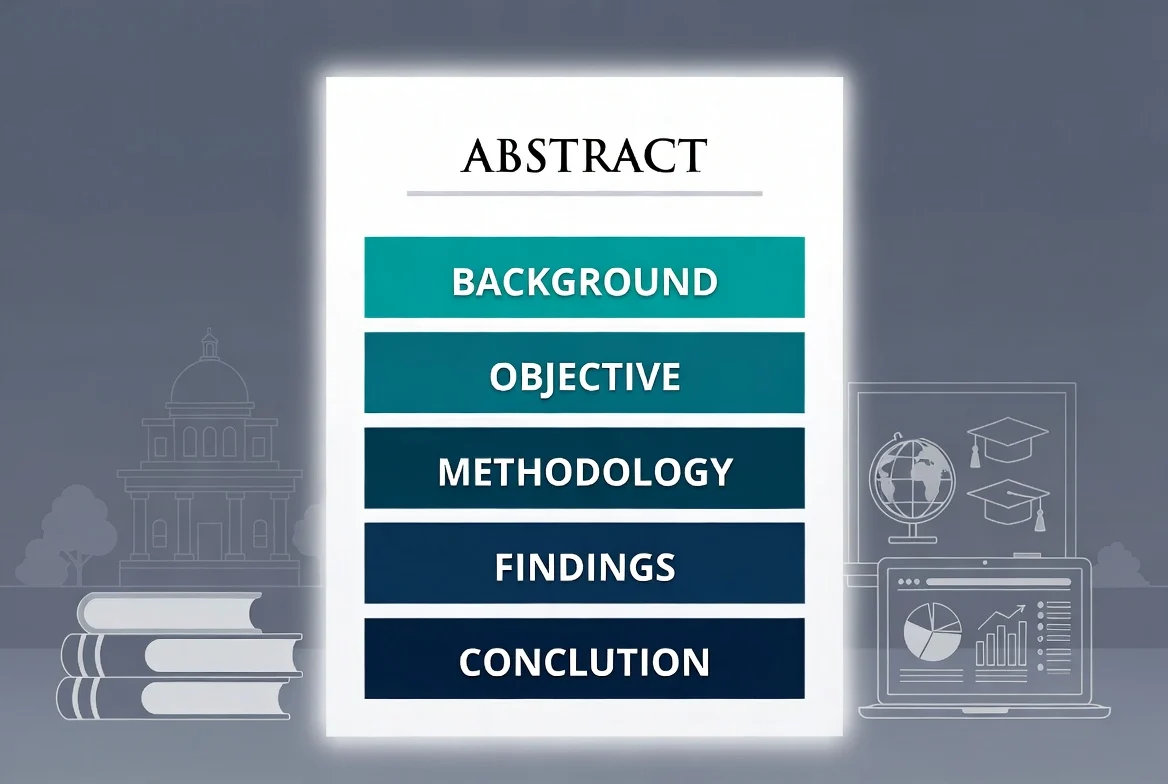
The good news? Writing a strong abstract follows a proven formula: five essential components that work like a mini-story of your research. Master them, and your abstract becomes a powerful gateway to your full paper.

In this 8-minute read, you’ll discover exactly what those five components are, why they matter for education research, and how to nail each one. You’ll also see real examples pulled straight from papers published in the Journal of Educational Leadership, Science, Vocational and Technology Management (JELSVTM)—a peer-reviewed outlet focused on practical, context-rich studies from Nigerian higher and secondary education.
Let’s turn your next abstract from “good enough” into “must-read.”
Why Abstracts Matter More in Education Research
Education journals receive hundreds of submissions yearly. Reviewers spend an average of 3–5 minutes per abstract before deciding to read further (or reject). Your abstract must:
- Stand alone (reviewers shouldn’t need the full paper to understand it)
- Highlight relevance to real-world teaching, policy, or leadership challenges
- Convey rigor without overwhelming technical jargon
- Spark curiosity about your findings and implications
In education specifically, abstracts often influence policy uptake—whether it’s improving lecturer effectiveness in federal colleges or boosting student performance in physics or biology. Get it right, and your work can shape classrooms across Nigeria and beyond.
The 5 Essential Components of a Strong Abstract
Every high-impact education abstract contains these five building blocks. They don’t have to appear in separate paragraphs (many JELSVTM papers weave them fluidly), but they must all be present.
1. Background (The “Why This Matters” Hook)
Set the scene in 1–2 sentences. Describe the real-world problem or gap in education practice, policy, or theory. Use context that resonates with your audience—e.g., persistent low performance in core subjects, institutional challenges in colleges of education, or emerging issues like AI in assessment.
Tip for education papers: Ground it in Nigerian or African realities when relevant. Reviewers appreciate context-specific urgency.
Real JELSVTM example (from “Institutional Factors as predictors of Lecturers’ Teaching Effectiveness in Federal Colleges of Education in North East, Nigeria” by Gayus et al.):
“This study investigated Institutional Factors as predictors of Lecturers’ Teaching Effectiveness in Federal Colleges of Education in North East, Nigeria.”
The authors immediately signal a pressing national issue: quality teaching in under-resourced institutions. No fluff—just clear problem framing.
2. Objective (The “What This Study Did” Statement)
State your research purpose, questions, or aims. This is the heartbeat of the abstract. Be specific: Are you testing a relationship? Evaluating an intervention? Exploring perceptions?
Tip: Use active language (“This study examined…”, “This study investigated the effects of…”). One crisp sentence is usually enough.
JELSVTM example (from “Relationship Between Social Media Usage And Secondary School Students’ Academic Performance In Physics In Adamawa State, Nigeria” by Hassan Yuguda et al.):
“This study examined the relationship between social media usage and secondary school students’ academic performance in Physics in Adamawa State, Nigeria, focusing specifically on Facebook, WhatsApp, and TikTok.”
Clear, focused, and immediately tells reviewers the scope.
3. Methodology (The “How It Was Done” Snapshot)
Give a concise overview of your approach so readers trust the rigor. Mention design, population/sample, instruments, and analysis—without drowning in details.
Tip for education research: Highlight ethical or practical choices (e.g., quasi-experimental design in real classrooms, validated questionnaires, or stratified sampling). This reassures reviewers of feasibility in school settings.
JELSVTM example (from “Scaffolding Teaching Strategy as a Tool for Enhancing Biology Students’ Academic Performance…” by Ummul Muhammed Hamman et al.):
“The study adopted the pre-test, post-test, non-equivalent non-randomized control group, quasi-experimental research design. The population was SS II Biology students in Yola South metropolis. The sample… was 178 students… The instrument… was Biology Performance Test (BPT)… Cronbach alpha… reliability coefficient of 0.86… Analysis of Covariance (ANCOVA) was used…”
Short, credible, and shows methodological soundness without excess.
4. Findings (The “What We Discovered” Payoff)
This is where reviewers lean in. Report the most important results—quantitative where possible (means, p-values, effect sizes) or key qualitative insights. Be precise but selective.
Tip: Lead with the most impactful finding. Use numbers sparingly but meaningfully—they add weight in education studies.
JELSVTM example (same scaffolding paper):
“The findings of the study showed that there was [a] mean difference between scores of students taught with scaffolding teaching strategy (39.02) and those taught with Lecture method (26.14) in favor of scaffolding teaching strategy…”
Or from the institutional factors paper:
“The findings revealed that there is a significant relationship between administrative procedures and lecturers’ teaching effectiveness (F(1, 328) = 87.376, p < 0.05)… [and] multiple institutional factors… (F(1, 328) = 22.061, p < 0.05).”
Concrete evidence that convinces readers the study delivers value.
5. Conclusion (The “So What?” and Forward Look)
End with implications, recommendations, or broader impact. Link back to the original problem and suggest practical next steps for educators, policymakers, or future researchers.
Tip: This is your chance to show real-world relevance—especially vital in applied education research.
JELSVTM example (scaffolding strategy paper):
“It was recommended that biology teachers, and science teacher educators should adopt Scaffolding instructional strategy when teaching in order to enhance students’ achievement in biology…”
And from the institutional factors paper:
“Based on the findings… Management of Colleges of Education should streamline and standardize administrative procedures… Heads of the institutions should invest in upgrading and maintaining instructional facilities…”
Strong, actionable close that leaves reviewers thinking, “This belongs in our journal.”
Common Pitfalls That Sink Education Abstracts
- Too vague on findings (“Results were significant” — significant how?)
- Missing implications — reviewers want to know why your study matters for classrooms or policy.
- Overloading with references or acronyms — save those for the full paper.
- Exceeding 250 words (most journals cap at 150–250).
- Writing the abstract first — always draft it last, after the full paper.
Step-by-Step Guide to Writing Your Next Abstract
- Finish your full paper.
- Highlight the single most important sentence from each section (intro, methods, results, discussion).
- Weave them into the five components above.
- Write a rough draft (aim 200–220 words).
- Cut ruthlessly—every word must earn its place.
- Read it aloud. Does it flow like a compelling mini-story?
- Get a colleague to review: Can they understand your study without the full paper?
Full Example Breakdown (JELSVTM Paper)
Here’s how the five components flow seamlessly in the abstract of “Students’ Perception of Ethical Challenges in Integrating Artificial Intelligence into the Assessment of Business Education Students in University of Benin” (Owie & Edomwande):
- Background: Students acknowledge AI’s potential but raise concerns.
- Objective: Explored students’ perception of ethical challenges…
- Methodology: Descriptive survey… population of 51… self-structured questionnaire… descriptive statistics.
- Findings: Reserved about fairness, transparency… concerns about data privacy…
- Conclusion: Recommended institutions address algorithmic bias, ensure data protection, and enhance AI literacy.
One paragraph, five components, maximum impact.
Final Thought: Your Abstract Is Your Research’s First Impression
In education research, your abstract isn’t just a summary—it’s an invitation. It tells busy reviewers (and later readers, funders, and policymakers) that your work is relevant, rigorous, and ready to make a difference in Nigerian classrooms, lecture halls, or national education policy.
Master these five components—background, objective, methodology, findings, and conclusion—and you’ll stop hoping your paper gets noticed. You’ll know it will.
Ready to write your strongest abstract yet? Open your latest manuscript, apply this framework, and watch the difference. Then submit it confidently to JELSVTM or your target journal.
Your research deserves to be read. Make the abstract impossible to ignore.